Federal SDLC Compliance Software: CMMC SDLC Evidence, SSDF-Mapped Gates, and Continuous ATO Evidence for AI-Accelerated Development
Prove your AI-accelerated development followed its controls.
In the language your assessor already speaks.
Federal software teams are under two pressures at once: ship faster with AI, and prove to an assessor that everything you shipped was governed. SDLC Playbook produces the tamper-evident, framework-mapped evidence that your software-development process followed its controls, continuously, as the work happens, not reconstructed the week before an audit.
Human review that can’t keep up with AI output is “compliance theater, not assurance.”
The Department of Defense’s own AI4SDLC guidance says it plainly: AI is entering federal software workflows faster than governance can keep pace, and a human review that can’t keep up with AI output volume is compliance theater, not assurance. The guidance calls for provenance on every AI-generated artifact, an audit trail treated as a first-class artifact, and AIBOM completeness as a security metric.
SDLC Playbook is the layer that produces provenance and the audit trail for the software-development lifecycle today; AI bill-of-materials fields are captured on evidence and are being surfaced.
Development-process evidence, mapped to the software-development control families inside your authorization.
Not every framework is the same kind of obligation. A mandatory contractual requirement and a voluntary baseline demand different evidence in an audit. SDLC Playbook maps your development-process evidence to the ones that apply to you.
Most teams can name the law and the standard. Fewer can say what evidence each one demands.
Cross the four things an assessor asks for with the kind of obligation you are under, and every cell is a piece of evidence you either have or do not. This is what SDLC Playbook produces in each one today, with the gaps stated.
Before your next assessment, the question is not “are we compliant?” It is “which of these cells can we hand over on request?”
We produce the evidence for the software-development slice of your package. Your GRC platform or eMASS assembles the full authorization. We feed it; we don’t replace it.
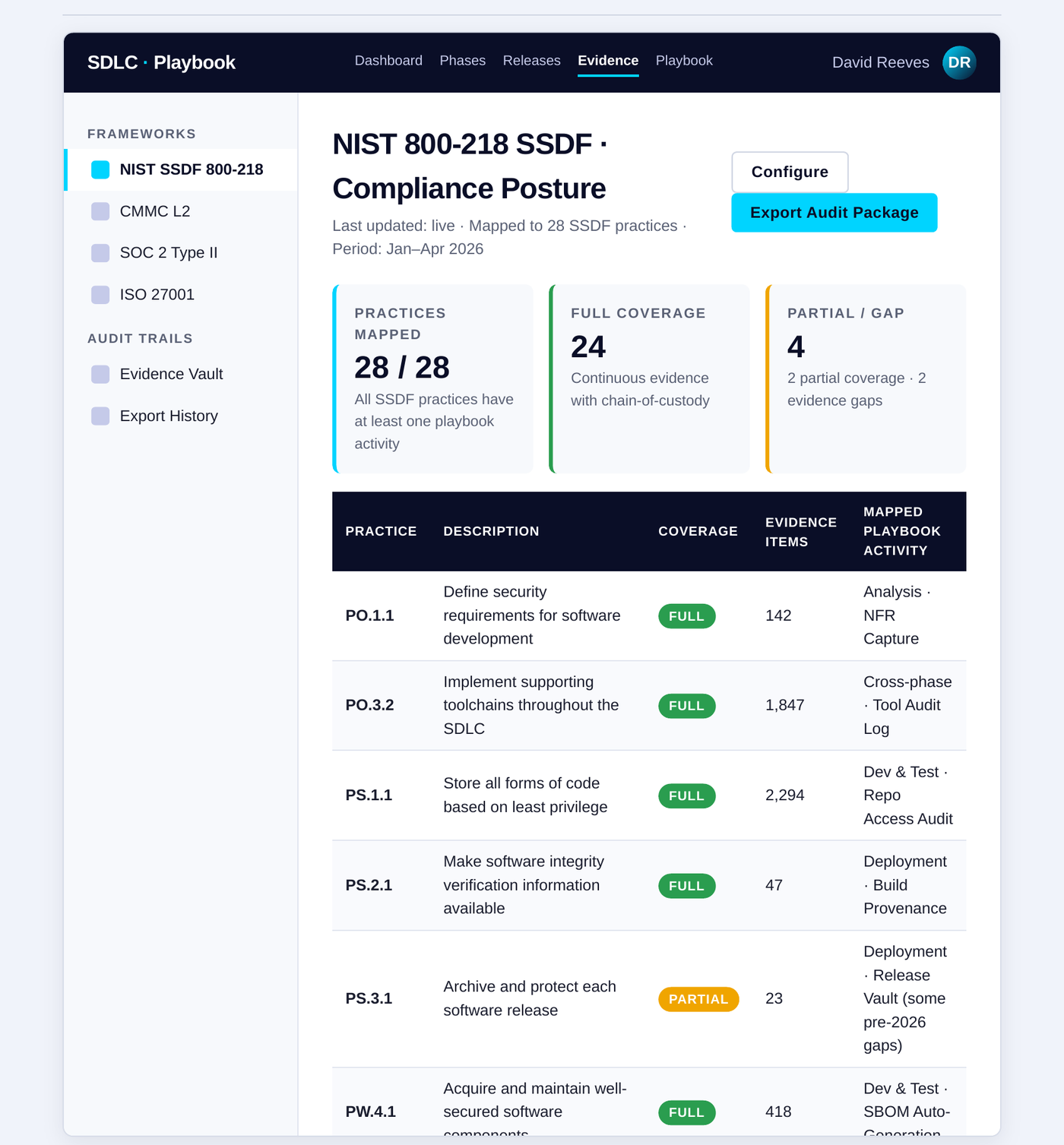
Practice-level posture with evidence counts. Full coverage, partial coverage, and gaps are visible before the assessor asks.
CMMC-ready evidence. SSDF-mapped gates.
CMMC-ready SDLC evidence
Every code review, approval, and gate captured and mapped to the control it satisfies.
SSDF-mapped gate enforcement
The deploy button stays closed until the risk-appropriate evidence exists and is proven.
AI-authorship provenance
For every AI-generated change: which model, which agent, and what human governed it.
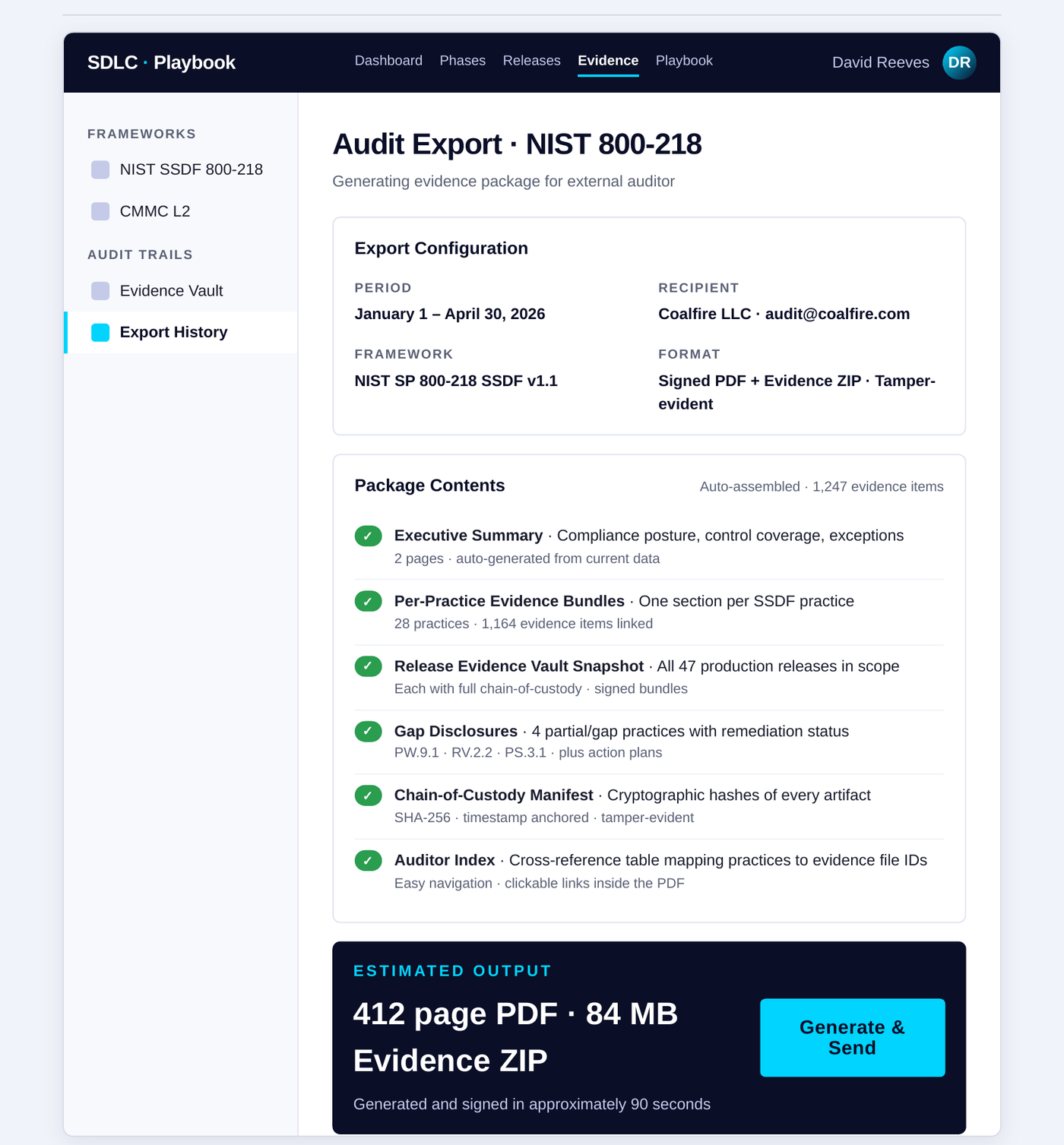
Evidence export with SHA-256 anchoring, a chain-of-custody manifest, and OSCAL (assessment results, assessment plan, component definition). The assessor drills from the control to the proof.
Traditional ATO is a snapshot every three years. Continuous authorization needs continuous proof.
Federal is moving to continuous authorization, which requires ongoing proof that controls are still operating. SDLC Playbook is built for exactly this: it governs continuously from a baseline you set, and produces the continuous software-development-control evidence a cATO needs.
A point-in-time consultant snapshot can’t do that. A continuous evidence platform can.
Four questions about every AI-generated change that ships.
What could it access, what could it change, who approved that capability, and what evidence shows it stayed inside those boundaries. Most teams can’t answer the fourth.
SDLC Playbook is built to answer all four, with tamper-evident evidence, not a screenshot and a promise. When a gate has to be overridden, the override itself becomes evidence: justification, approver, follow-up task, and audit tag, logged where the assessor can see the request, the reason, and the resolution.
Process that bends without breaking.
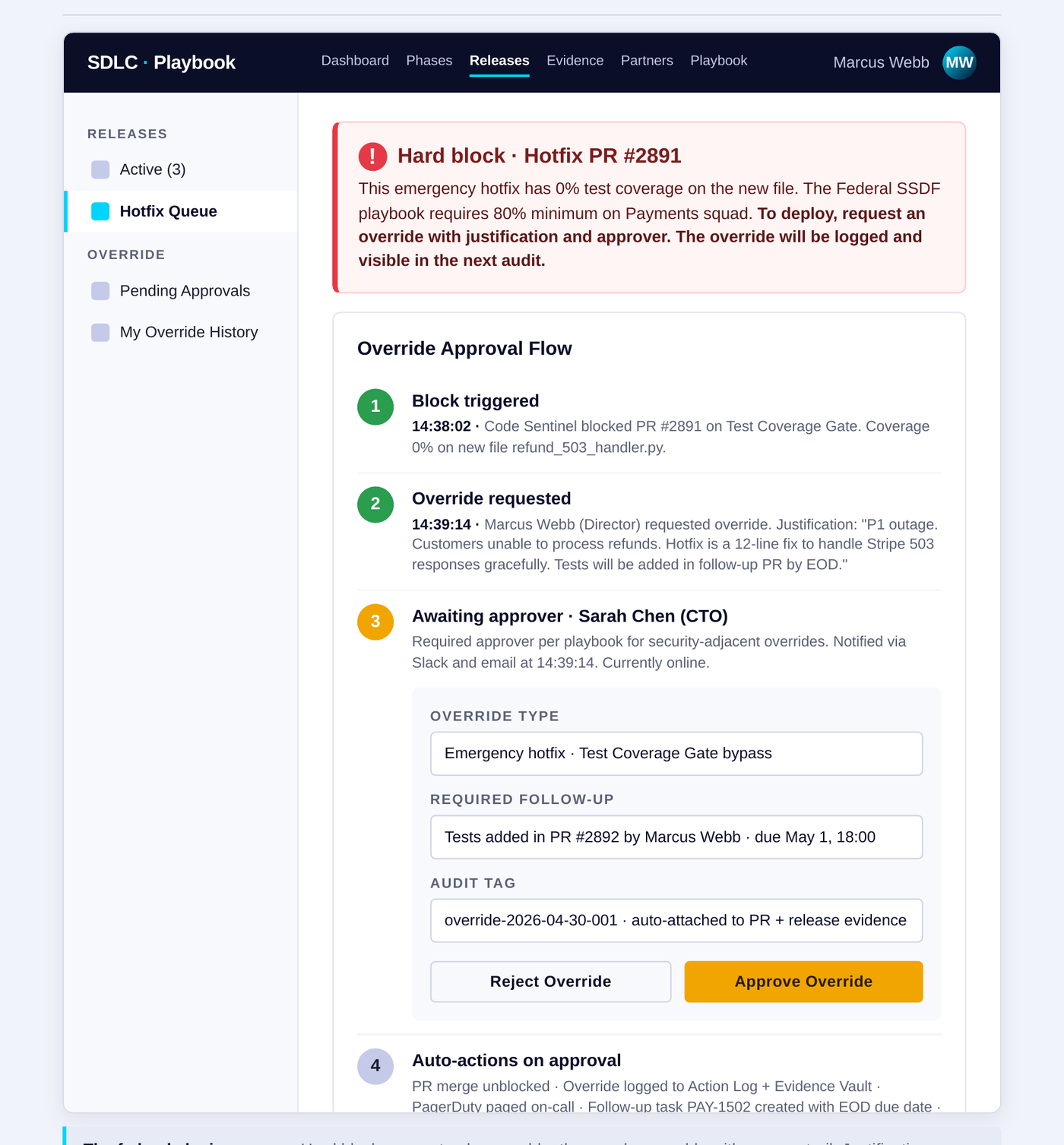
Governance evidence that holds up.
Governance Drift Detection
Continuously reconciles the governance you declared against the execution we observe. Every control reports CONFIRMED, OBSERVED_ONLY, or NOT_OBSERVED_IN_WINDOW, so a gap is never hidden behind a green check.
Tamper-evident evidence with verify
Every evidence item carries a canonical-JSON SHA-256. A verify endpoint confirms the item has not been altered since capture.
Cross-framework mapping
One finding lights up every regime the control belongs to: SSDF, NIST 800-171, DoD RMF control families, and SOC 2 at once.
Chat approval as evidence
A human sign-off made in Slack or Microsoft Teams is captured at the moment it happens as tamper-evident, control-mapped evidence. Commercial-cloud Slack and Teams today; GCC-High is not supported. Mapping to SSDF PW.8.2 is partial.
Scanners prove the code was scanned. GRC tools collect evidence at audit time. Neither proves the process was governed.
Neither proves that the AI’s work was reviewed, traced to a requirement, and gated before it shipped. That’s the layer we own, and the one your assessor increasingly asks about as AI writes more of your code. Read the Vanta comparison or the full comparison page.
On the roadmap
NIST 800-218A mapping for AI-generated code. FedRAMP SDLC control-family mapping (SA-11, SA-15, CM-3, SI-2, RA-5). Per-change autonomy-level tagging on AI-generated changes. FedRAMP authorization. These are in progress and not yet shipped. We say so here so you don’t have to ask.
What federal buyers ask, answered.
What is CMMC SDLC evidence?
The proof that your software-development practices, such as code review, approval, testing, and release gating, actually ran for each change, mapped to the NIST 800-171 control each one satisfies (the CMMC Level 2 baseline). SDLC Playbook captures that evidence as the work happens and stores it tamper-evident, so it is retrievable at assessment time rather than reconstructed.
Which frameworks does SDLC Playbook map development evidence to?
Grouped by the kind of obligation each one is. Mandatory contractual: NIST 800-171 rev2 for CUI environments (shipped; also the control baseline for CMMC Level 2, though CMMC-specific packaging such as practice IDs, SPRS scoring, and assessment objectives is not implemented), DoD RMF Implement, Assess, and Monitor evidence for the SDLC control families (shipped), and FedRAMP (on the roadmap; aligned to FedRAMP Moderate controls today). Certifiable standard: SOC 2 (shipped). Voluntary baseline becoming an expectation: NIST SSDF 800-218 (shipped). We produce the evidence for the software-development slice of your package; your GRC platform or eMASS assembles the full authorization.
Does SDLC Playbook export evidence in OSCAL?
Yes. OSCAL evidence export is available today: assessment results, assessment plan, and component definition download alongside the PDF audit package and the evidence ZIP with SHA-256 anchoring and a chain-of-custody manifest. OSCAL System Security Plan output is not produced.
How does SDLC Playbook support continuous ATO (cATO)?
It governs continuously from a baseline you set and produces ongoing software-development-control evidence as changes ship, which is what a continuous authorization needs in place of a periodic snapshot. Delta evidence accumulates with each change rather than being assembled before a review.
What does the override workflow look like to an assessor?
Every override captures justification, an approver with role authority, a follow-up remediation task, and an audit tag. It is logged to the tamper-evident evidence vault with SHA-256 anchoring, so the assessor sees the request, the reason, and the resolution.
How does SDLC Playbook relate to DoD AI4SDLC guidance?
The DoD AI4SDLC guidance calls for provenance on every AI-generated artifact, an audit trail treated as a first-class artifact, and AIBOM completeness as a security metric. SDLC Playbook records which model and agent produced each AI-generated change and which human governed it, and keeps that trail as evidence alongside the change.
Is SDLC Playbook FedRAMP authorized?
Not yet. FedRAMP authorization is on the roadmap. Federal teams who need to prove AI-accelerated development was governed in the meantime should request a design-partner conversation to discuss deployment options.
What does the federal design-partner program include?
We are working with a small number of federal software teams and defense contractors to prove SDLC Playbook against real ATO and CMMC requirements. Design partners get early access and direct input on the framework mapping in exchange for feedback and reference rights.
Shipping AI-accelerated software into a regulated environment?
Prove it was governed.
We’re working with a small number of federal software teams and defense contractors to prove SDLC Playbook against real ATO and CMMC requirements. If you need to prove your AI-accelerated development was governed, let’s talk.